Published · 5 min read
How to Choose the Right Size of Artwork for Your Wall
Measure the wall, relate the work to the furniture, count the mat and frame, test with paper — a practical method for choosing the right artwork size.
Most people choose a work by its image and discover its size when it arrives. That order is understandable, and it is why so many good pictures end up looking lost on a wall, or crowding one. Size is not a detail to settle afterwards. It decides whether the image is seen at all, and it is far easier to get right before buying than after.
Start with the wall, not the work
Measure the wall before you look at a single listing. Not the whole wall in the abstract, but the part the work will actually occupy: the width between a door frame and a window, the stretch above a sofa, the space between two shelves. Note the height of the ceiling and of any furniture beneath. Write the numbers down; memory rounds everything to "about a metre".
Then ask where people will usually be when they look at it. A wall seen from across a living room and a wall seen from a corridor half a metre away need very different things, even if they measure the same.
Relating the work to the furniture
When a work hangs above a sofa, a sideboard or a bed, it belongs to the furniture more than to the wall. Two proportions do most of the work:
- Aim for about two thirds of the furniture's width, whether that is one work or a group read as one block.
- Leave 15 to 20 cm between the top of the furniture and the bottom of the frame, so the two read as a pair without looking stuck together.
Two thirds is a guide, not a measurement to hit to the centimetre. Somewhere between half and three quarters usually looks deliberate. Well under half is where problems start.
The most common mistake: one small work on a big wall
A single small print centred over a three-seat sofa is the mistake almost everyone makes once. The work itself is rarely the problem; its isolation is. There are three honest fixes:
- Group it. Add one or two works of the same format and treat them as a single block.
- Move it to a narrow wall. The strip beside a door, the side of a bookcase or the wall between two windows suits a small format far better than a broad expanse.
- Put it where it is seen from close up. A corridor, a landing, above a desk. A small work asks to be approached, so give it a place where people naturally are.
The frame is bigger than the print
This is the arithmetic people forget. A print's size is the paper; what goes on the wall is the paper plus whatever surrounds it. A mat adds a border on every side, so its width counts twice in each direction, and the frame's moulding does the same.
Take a 40 × 30 cm print with, say, a 6 cm mat all round: 40 + 12 by 30 + 12 gives 52 × 42 cm. Add a slim moulding 2 cm wide and you add another 4 cm each way: 56 × 46 cm on the wall. The same treatment on a 60 × 40 cm print gives 76 × 56 cm. Those figures are an example, not a standard; mats and mouldings come in many widths, and a wider mat makes a small print read noticeably larger. The point is to plan with the framed size, never the print size.
Test with paper before you buy or drill
Cut rectangles of kraft paper or newspaper to the framed size you expect and tape them to the wall. Leave them up for a day or two and look at them at different times, from the places where you actually sit and walk. Paper is brutally honest: a size that seemed generous on a screen often turns out timid, and occasionally the reverse.
For a group, cut one rectangle per frame, space them as you intend, and judge the outer edges of the whole arrangement against the furniture. A group is one block: its width is measured from the outside edge of the first frame to the outside edge of the last, gaps included.
Viewing distance, as a rule of thumb
A work you see from far away can be larger; one you pass at arm's length can be smaller. A rough rule of thumb, and no more than that: if you usually stand two or three metres away, a work much under half a metre wide will tend to read as a spot rather than an image. The paper template will tell you more than any rule.
Orientation and ceiling height
A landscape format emphasises width and settles naturally over long, low furniture. A portrait format draws the eye upward, which suits a narrow wall, a stairway, or a room with a high ceiling where a horizontal work can look squashed against the furniture with a great deal of empty wall above. In a low-ceilinged room, the opposite tends to hold: a tall work or a vertical stack can make the ceiling feel lower still.
A worked example: going larger or buying two
ArtMarket, the shop this site links to, sells its signed photographs in a standard 40 × 30 cm size, with 60 × 40 cm printed to order. Prints are shipped unframed and rolled in a tube, so the framed size is your decision. Using the example framing above:
- Above a 200 cm sofa, two thirds is about 133 cm. One framed 60 × 40 (76 cm wide) covers well under half. Two framed 40 × 30s side by side with a 6 cm gap come to 56 + 6 + 56 = 118 cm, which sits comfortably in range.
- Above a 240 cm sofa, two thirds is 160 cm. Two framed 60 × 40s with a 6 cm gap make 76 + 6 + 76 = 158 cm.
- On a narrow wall 90 cm wide, a single framed 60 × 40 fills it with presence; two of anything would be cramped.
The price arithmetic is simple too. On a €65 work, the larger size is €145; two different works at the standard size come to €130. On the three €95 works, the larger size is €195 against €190 for two standard prints. Remember to add framing, which for two frames will usually cost more than for one.
When to go larger, and when to buy two
Go larger when one image has to hold a wall alone, when it will be seen from a distance, or when its interest lies in space and scale. A description like that of LumièreVue's Endless Horizon — a vast expanse of deep blue and rolling waves, under a sky that blends into the distant horizon — is the kind of image that gains from room to breathe.
Buy two when the wall is wide and flat, when two images talk to each other, or when you would rather build a group over time. And keep the standard size for works meant to be approached: Serena's Fading Steps, a single footprint in sand as a wave erases it, is an image of textured grains and a small moment, the kind that suits a close viewing spot.
Whatever you choose, measure first, count the mat and frame, and let a sheet of paper on the wall have the final word.
Works mentioned in this guide
Signed, limited-edition photographs listed on ArtMarket, our commercial partner — for when the reading turns into wanting a real print.
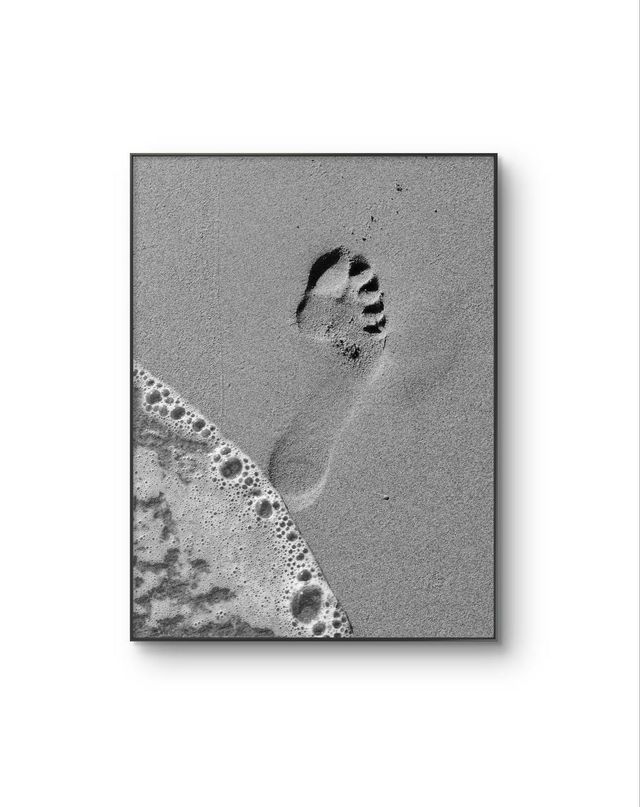
Fading Steps
Serena
Black & white photography · Edition of 25 · Signed
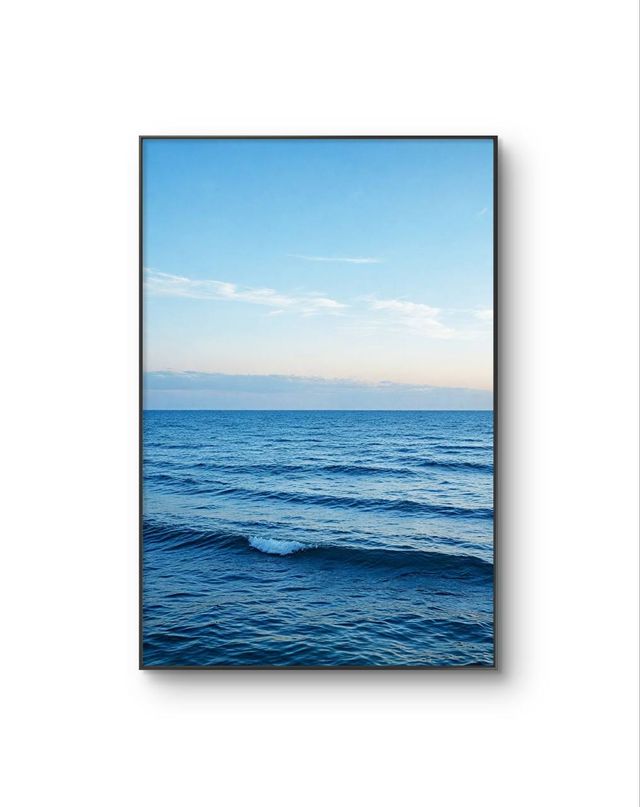
Endless Horizon
LumièreVue
Colour photography · Edition of 25 · Signed
Listed on ArtMarket, our commercial partner. Edition details and pricing are on their site.
Continue reading
- How to Frame a 45 × 30 Photography Print: A Practical GuideArt prints ship rolled and unframed. Here is how to flatten, mat, glaze and hang a 45 × 30 photograph without damaging it — and what it actually costs.
- How to Choose Art for Your Home: Wall, Scale and MoodStart from the wall, not the artist: scale against furniture, mood room by room, colour or black and white, light, framing costs and living with a work first.
- How to Start Collecting Photography: A Practical GuideWhat makes a photograph collectable, the print processes worth knowing, where to look in France, how to give a collection a thread and how to buy online.